 Dutch
DutchThe digital sovereignty model
This is a preview article from my upcoming book:
Digital Sovereignty in Europe - Architecture and Strategies for Technological Independence
Digital sovereignty can be discussed based on a structured model (shown below) that captures the full scope of this complex topic in several building blocks.
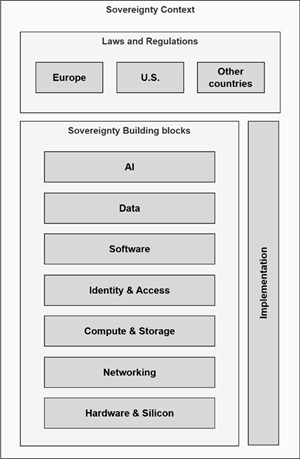
The outermost building block defines the Sovereignty Context: the overarching environment in which all digital sovereignty decisions get made.
Laws and Regulations describe legislation relevant to sovereignty across Europe and U.S. and – in less detail – in other countries. Regulatory landscapes differ significantly by geography. For instance, rules about data residency in Europe bear little resemblance to those in force across Southeast Asia or the U.S.
The core of the model consists of the Sovereignty Building Blocks – seven foundational building blocks running from Hardware and Silicon up through AI. Together they form the technical pillars of a sovereign digital environment. These building blocks describe:
- Hardware and silicon form the physical foundation of digital sovereignty. Control over processors, open and trusted hardware, data centers, and the semiconductor supply chain determines whether critical digital infrastructure remains available, secure, and free from excessive dependence on foreign suppliers.
- Networking connects systems, users, and services across organizations and countries. Sovereignty at this layer depends on control over internet connectivity, routing, network services, and communication architectures.
- Compute and storage provide the infrastructure where applications run and data is processed. Sovereignty requires architectures that minimize vendor lock-in, support portability (containerization, infrastructure as code, portable cloud services), and ensure that critical workloads can continue operating regardless of changes in cloud providers or political circumstances.
- Identity and access determine who can use systems and what they are allowed to do. Every digital service needs to verify who users are and what they are allowed to do. To stay secure and independent, organizations must keep control over their identity systems. This means using open standards, connecting systems through federation, and carefully managing privileged access.
- Software provides the functionality that organizations rely on every day. Software sovereignty focuses on reducing dependency on proprietary ecosystems through open standards, open-source software where appropriate, secure software supply chains.
- Data is often an organization's most valuable digital asset. Data sovereignty is about maintaining control over where data is stored, how it is classified and protected (for instance using encryption), who can access it, and under which legal jurisdiction it is processed throughout its lifecycle.
- Artificial intelligence sits at the top of the sovereignty stack because it depends on every underlying building block. AI sovereignty involves controlling models, training data, AI-specific compute resources, and deployment choices so that organizations can benefit from AI while remaining compliant, transparent, and strategically independent.
Running alongside them is the Implementation building block, which reflects a straightforward but important point: digital sovereignty isn't just a concept. It has to be actively designed, built, and maintained.
This entry was posted on Tuesday 30 June 2026

